Written by Dr. Marcus J. Serven
“Train up a child in the way he should go; even when he is old he will not depart from it.” Proverbs 22:6
Introduction:

This coming July 4, 2026 we will celebrate the 250th anniversary of the founding of our country. Of course, when the Declaration of Independence was signed in Philadelphia, our independence from Great Britain was far from certain. It was only through the blessing of God that the yoke of tyranny would be thrown off after seven long years of war. Many individuals of strong courage were raised-up during that troublesome season, but it is difficult to find a better example than George Washington who courageously led our troops into battle, and who would later serve as the first President of the United States in two terms (1789-1793 and 1793-1797). He is widely recognized as the preeminent leader of the American Revolution and the Father of our country.
Before that, however, George Washington was a surveyor, soldier, owner of a plantation, representative from Virginia to the Continental Congress, faithful member of the Episcopal Church, and the Commander and Chief of the Continental Army. He consistently depended upon the Providence of God to defeat a more numerous and much better equipped British Army during the Revolutionary War. But, what is it that shaped his character and produced in him a resolute determination to oppose all evil and oppression? Surely, it was the Christian faith which took root in him by the grace of God and that matured through the faithful efforts of his father and mother. It was said of him that he sought to please God more than to receive the praise of men.
A Life to Be Studied:
What key people and significant events shaped the life of George Washington? Below are three examples from Washington’s life—the first being the influence of his father; the second an excerpt from his personal prayer book; and the third the time General Washington was observed praying in a hidden grove of trees at Valley Forge. Each example illustrates the deeply held faith in Jesus Christ that was evident in Washington’s life.
— The Cabbage Seeds:

George Washington’s father, Augustine Washington, came-up with a clever way to instruct his young son in how God created the universe. The father went into the vegetable garden near a pathway that his son always walked on. In the soft soil of the garden he spelled out his son’s full name with tiny cabbage seeds. After a few weeks went by and as young George was walking by the garden bed he saw his name completely spelled out in large letters. Having seen them he quickly found his father and said, “O Pa! Come here! Come here!” “What is the matter, my son, what’s the matter?” George replied, “O come here, I tell you, Pa, come here! And I’ll show you such a sight as you never saw in all your life time.” Leading his father to the site, George pointed at the newly sprouted plants that spelled out his name:
G – E – O – R – G – E — W – A – S – H – I – N – G – T – O – N
“There Pa!” said George, quite in an ecstasy of astonishment, “did you ever see such a sight in all your life time?” “Why it seems like a curious affair, sure enough, George!” “But, Pa, who did make it there?” His father answered, “It grew by chance, I suppose my son.” “By chance, Pa! O no! no! it never did grow there by chance, Pa; indeed that it never did!” “Well George, such a thing might have happened, though you never saw it before!” “Yes, Pa, but I did never see the little plants grow up so to make one single letter of my name before. Now, how could they grow up so as to make all the letters of my name! And then standing one after another, to spell out my name so exactly! —and all so neat and even too, at top and bottom!! O Pa, you must not say chance did all this. Indeed somebody did it; and I dare say now, Pa, you did do it just to scare me, because I am your little boy.” His father smiled, and said, “Well George, you have guessed right—I indeed did it; but not to scare you, my son; but to learn you a great thing which I wish you to understand. I want, my son, to introduce you to your true Father.” “Aye! I know, well enough whom you mean, Pa. You mean God Almighty, don’t you?” “Yes, my son, I mean him indeed. He is your true Father, George.”
This tender conversation continued back and forth between father and son, so that in the end Augustine Washington had given his son, George, a memorable lesson in how the design and complexity of the universe points us to the One who made all things. God must give us faith to believe and trust in his Son, Jesus Christ; but all of creation cries out that there is a God who is our Creator. George Washington’s parents were engaged in covenantal evangelism. In other words, they sought to introduce their young son to the Lord who made all things, and to help him see his need for a Savior. Did this effort bear good fruit? It’s a fair question, to be sure. Fast forward fifteen years and we shall see the answer.
(Adapted from: Rev. Mason L. Weems, Life of Washington, 13-16)

— George Washington’s Prayer Book:
At twenty years old Washington wrote out a prayer book for his daily use. A man’s prayers, in many respects, reveal his true spiritual character. After reading his prayers it is difficult to not come away with the positive conviction that George Washington was indeed a Christian man. Below is a prayer from his own personal prayer book:
“Monday Evening — Most Gracious Lord God, from whom proceedeth every good and perfect gift, I offer to thy divine majesty my unfeigned praise & thanksgiving for all thy mercies towards me. Thou mad’st me at first and hast ever since sustained the work of thy own hand; thou gav’st thy Son to die for me; and has given me assurance of salvation, upon my repentance and sincerely endeavoring to conform my life to his holy precepts and example. Thou art pleased to lengthen out to me the time of repentance and to move me to it by thy spirit and by thy word, and by thy mercies, and by thy judgments; out of a deepness of thy mercies, and my own unworthiness, I do appear before thee at this time; I have sinned and done very wickedly, be merciful to me, O God, and pardon me for Jesus Christ sake; instruct me in the particulars of my duty, and suffer me not to be tempted above what thou givest me strength to bear…Be with me at the hour of death; dispose me for it, and deliver me from the slavish fear of it, and make me willing and fit to die whenever thou shalt call me hence…Pity the sick, the poor, the weak, the needy, the widows and fatherless and all that mourn or are broken in heart, and be merciful to them according to their several necessities. Bless my friends and grant me grace to forgive my enemies as heartily as I desire forgiveness of Thee my heavenly Father. I beseech thee to defend me this night from all evil, and do more for me than I can think or ask, for Jesus Christ sake, in whose most holy name & words, I continue to pray, Our Father, &c.”
— William J. Johnson, George Washington: The Christian, 28-29
In this prayer Washington acknowledged God’s sovereign rule over the entire world. He clearly articulated his understanding of the person and work of Jesus Christ. And, he confessed his own sin and his need for forgiveness from it through Jesus Christ. Last of all, he turned his attention to the needy all around him, and he interceded on their behalf. These are the marks of a true Christian.
— Washington’s Prayer at Valley Forge:
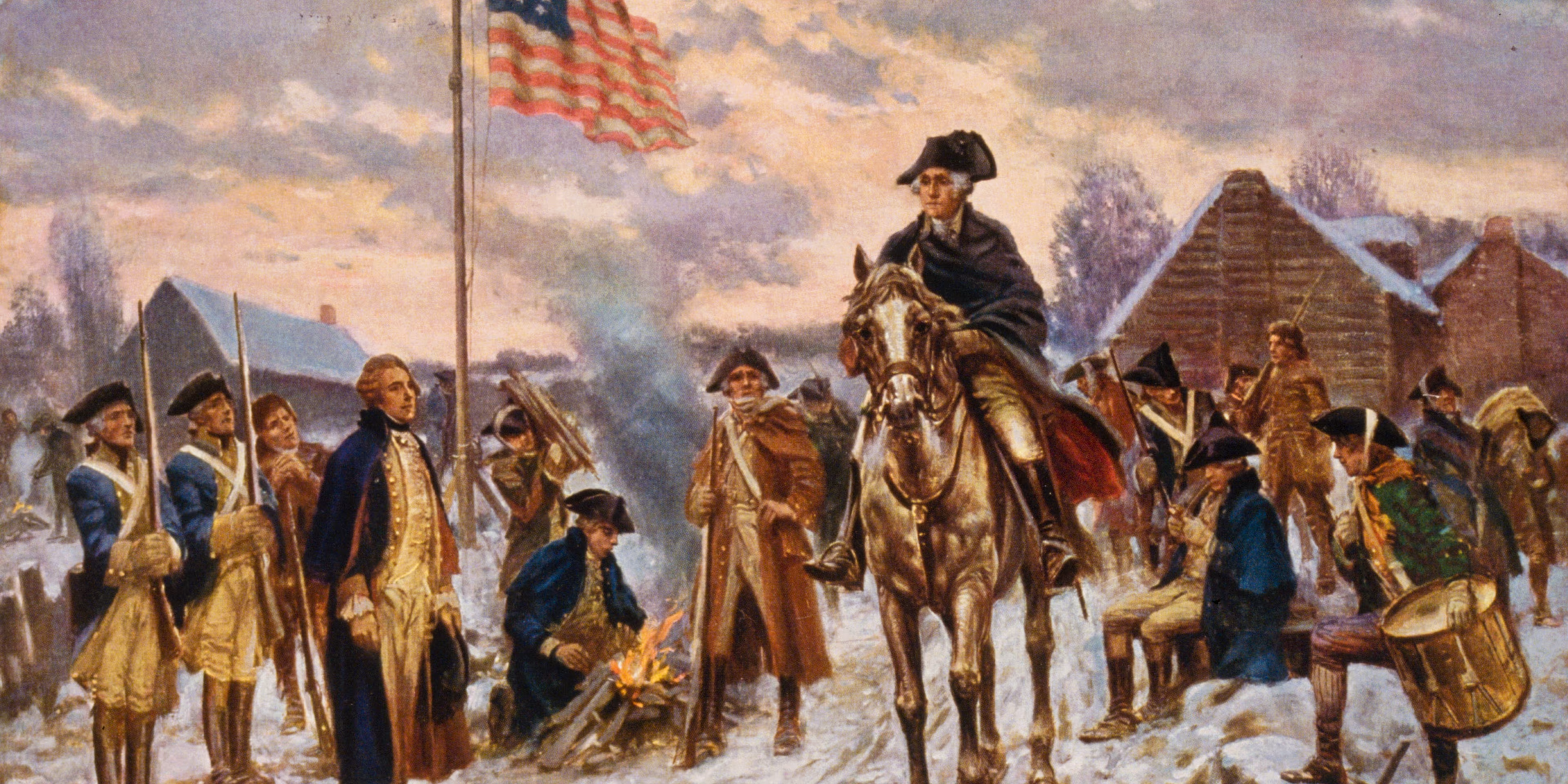
Several recent historians have asserted that George Washington was simply a Deist and not actually a Christian man. The deist believes that God is no more than a distant architect who created the universe and then quietly left it to its own destiny. They also argue that God is not involved in the affairs of men and nations. Instead, God is remote and disconnected from all human beings. In contrast to their assertions, however, this following anecdote regarding Washington’s prayer life shows how he believed otherwise:

“In the Winter of ’77, while Washington, with the American army lay encamped at Valley Forge, a certain good old friend, of the respectable family and name of Potts, if I mistake not, had occasion to pass through the woods near headquarters. Treading his way along the venerable grove, suddenly he heard the sound of a human voice, which as he advanced increased on his ear, and at length became like the voice of one speaking in earnest. As he approached the spot with a cautious step, whom should he behold, in a dark natural bower of ancient oaks, but the Commander in Chief of the American Armies on his knees in prayer! Motionless with surprise, friend Potts continued on the place till the general, having ended his devotions, arose, and with the countenance of angelic serenity, retired to headquarters: friend Potts then went home, and on entering his parlor called out to his wife, ‘Sarah, my dear! Sarah! All’s well! All’s well! George Washington will yet prevail!’ ‘What’s the matter, Isaac?’ replied she; ‘thee seems moved.’ ‘Well, if I seem moved, `tis no more than what I am. I have this day seen what I never expected. Thee knows that I have always thought the sword and the gospel utterly inconsistent; and that no man could be a soldier and a Christian at the same time. But George Washington has this day convinced me of my mistake.’ He then related what he had seen, and concluded with this prophetical remark—‘If George Washington be not a man of God, I am greatly deceived—and still more shall I be deceived if God do not, through him, work out a great salvation for America.’”
— William J. Johnson, George Washington: The Christian, 102-103
Concluding Remarks:
In these three examples we witness the true character of George Washington. He was a dedicated Christian man who humbled himself before Almighty God, and who depended upon God’s providential blessings throughout the course of his life. We can have confidence that God interceded in the events that brought about the founding of our country; examples abound of God’s providential deliverance from overwhelming odds! To be sure our country has not been perfectly righteous—from such failures we should actively repent. However, it is now our responsibility to faithfully serve God throughout our lives and to seek his glory in the civil sphere as well as in our own personal responsibilities. Let us begin by praying that God would raise-up other national leaders like George Washington within our own time—for the furtherance of God’s glory here on the earth.
Resources for Further Study:
Chernow, Ron. Washington: A Life. New York, NY: The Penguin Press, 2010.
Custis, George Washington Parke. Recollections and Private Memoirs of Washington. First published in New York, NY: Derby & Jackson, 1860; Bridgewater, VA: American Foundation Publications, Reprint, 1999.
Ellis, Joseph J. His Excellency: George Washington. New York, NY: Published by Alfred A. Knopf, 2004.
Fischer, David Hackett. Washington’s Crossing. Oxford, UK: Oxford University Press, 2004.
Flexner, James Thomas. Washington: The Indispensable Man. Illustrated Edition. New York, NY: The Sterling Publishing Company, 2012.
Johnson, William J. George Washington: The Christian. Arlington Heights, IL: Christian Liberty Press, 1992.
McCullough, David. 1776. New York, NY: Simon & Schuster, 2005.
The American Heritage History of the American Revolution. Edited by Richard M. Ketchum. New York, NY: American Heritage Publishing Company, 1971.
Weems, Mason L. The Life of Washington. Edited by Marcus Cunliffe. Cambridge, MA: Harvard University Press, 1962.
Dr. Marcus J. Serven, ThM and DMin
The Genevan Foundation – Copyright 2026 – All Rights Reserved